Booster System Sizing
CalculatorCalculates the required booster-set flow rate (Q) and head (H) for a residence or building.
1Booster-Set Flow · Q
Q = (A × B × T × f) ÷ 1000
units
people
L/day
table
Booster-Set Flow
–m³/h
Q = A·B·T·f ÷ 1000
2Head · H
H = (Floor Height × Number of Floors × Safety Factor) + 15 + Special Equipment
floors
m
mH₂O
Head
–mH₂O
≈ – bar · includes 15 m service-pressure allowance
Required duty: – m³/h flow and – mH₂O head for a booster set.
📖 How to use it
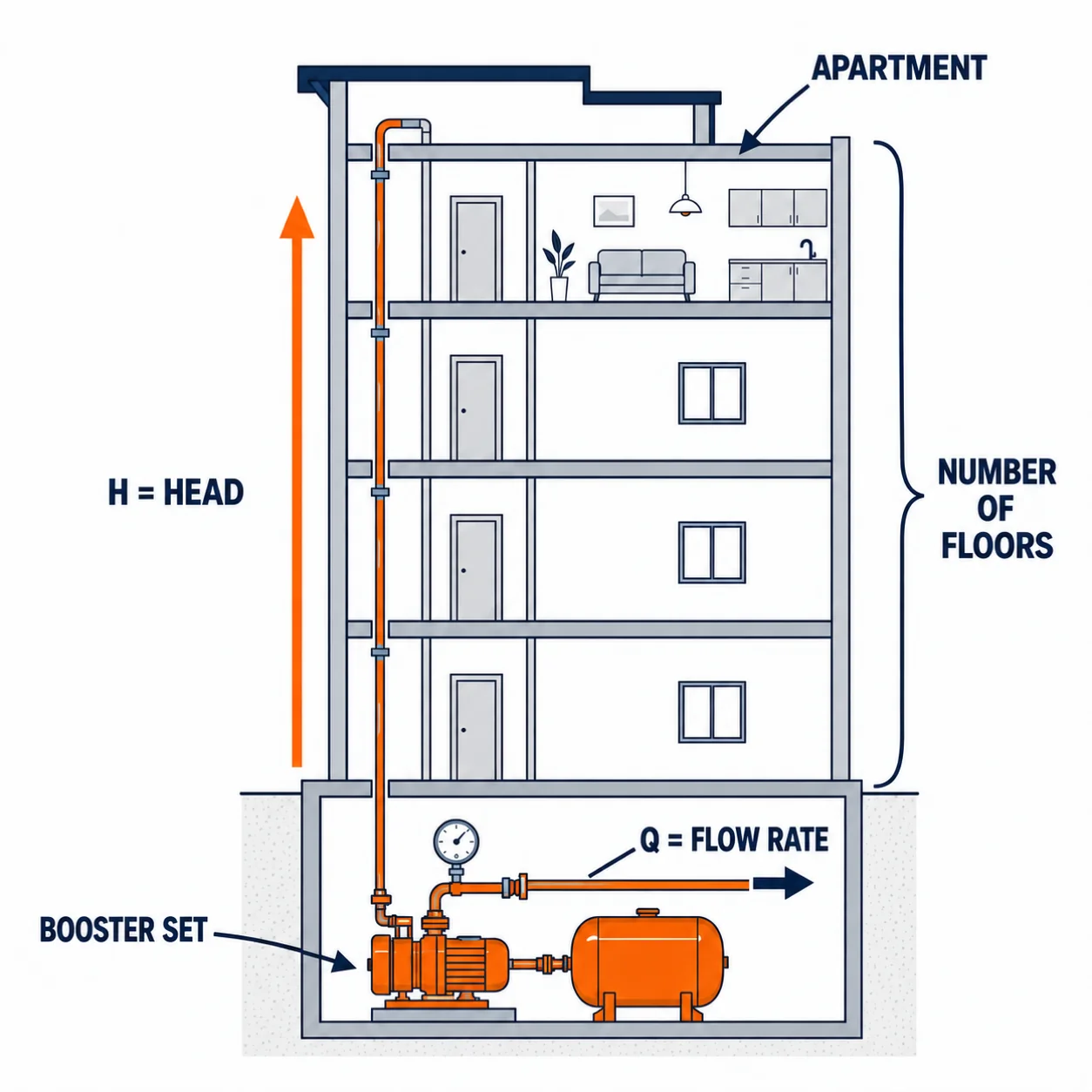
When municipal water pressure cannot reach the upper floors of a building, a booster set raises the pressure. This calculation determines the required flow rate (Q) and head (H), then recommends a product for that duty.
🏠 Real-world example: Consider a five-story, eight-unit apartment building. When someone on the top floor turns on the shower, the water barely flows because supply pressure is insufficient. A booster set solves the problem by delivering adequate flow and pressure.
What do the inputs mean?
- Number of Apartments: total independent dwelling units; determines water demand (flow).
- Number of Floors: from ground level to the top floor; determines required pressure (head).
- Floor-to-Floor Height / Building Condition / Special Equipment: refine the head requirement.
Step-by-step solution
- Define the duty with two values: flow (Q) = how much water, and head (H) = how much pressure is required.
- Flow: 8 apartments × 4 people × 150 L × 0,45 (diversity) ÷ 1000 = 2,16 m³/h.
- Head: 4 floors × 3 m × 1,20 + 15 (service pressure) + 10 (equipment) = 39 mH₂O.
- Best match for this duty: ETNA MİNİ-HİDRO-2 (4 floors / 8 apartments).
💡 Tip: Enter the actual apartment and floor counts. Inflating them will produce an unnecessarily large and expensive booster-set recommendation.